
Quick answer
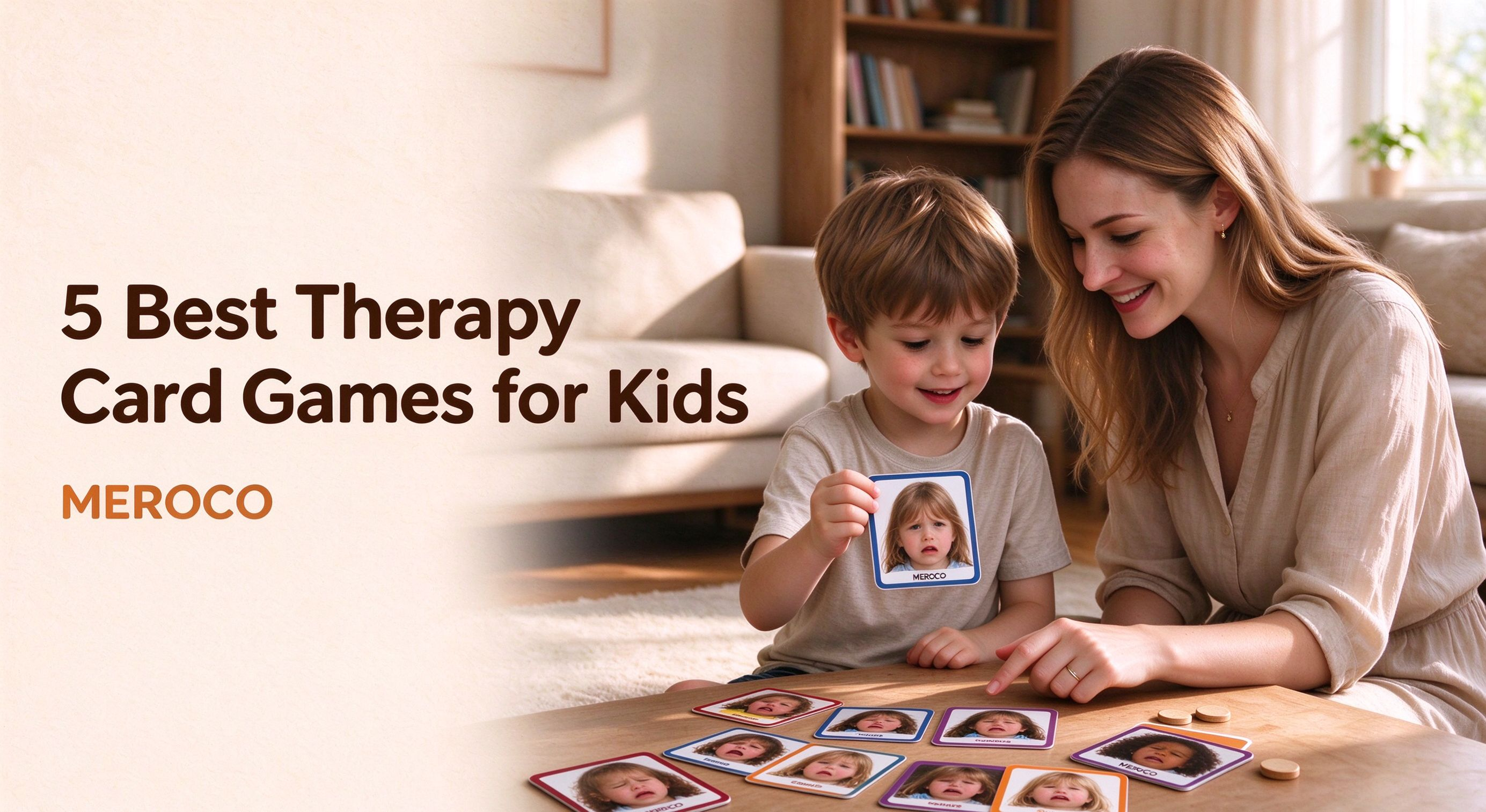
The best therapy card games for kids do one job: they get your child naming feelings out loud. Pick a set with real-photo faces, play ten minutes with one card at a time, and let your child win and lose a few rounds. If meltdowns or shutdowns replace words for weeks, ask your pediatrician about an evaluation.
“My brain feels all jumbled.” Your child says it over a scatter of cards, a half-finished puzzle, or nothing you can see at all — and you are left holding the jumble with no instructions. That sentence is exactly what therapy card games are built for. A feeling too big to explain becomes a card a child can point to, match, and post into a pocket. And pointing is something even a very quiet five-year-old will do.
Sticker charts, feelings storybooks, the gentle lecture in the rearview mirror — none of it answered the question you actually typed into the search bar: which games help, and how do you run one at home? This guide names five, walks through the minutes that make them work, and shows where games stop being enough. It is educational, not diagnostic — if the jumbled days are piling up, your pediatrician or a child therapist is the right next call.
Table of Contents
- Why Games Beat Lectures
- What Makes a Card Game Therapeutic
- The Five Games We Recommend
- Skills, Ages and Price Compared
- How to Lose on Purpose the Right Way
- What to Skip and What to Buy Instead
- Signs the Games Are Working
- When Play Isn’t Enough Anymore
- FAQ
- The Bottom Line
Why Games Beat Lectures
Explaining a feeling to a five-year-old is like describing a color to someone who has never seen it — the words land, but nothing connects. Games work because they make the feeling physical: a face to point at, a chip to place, a turn to take. Children ages 4 to 8 with stronger emotion vocabularies show better self-regulation regardless of verbal IQ, according to a 2025 study in the journal Emotion (n=252). A lecture never builds that vocabulary; twenty minutes of “which face is this?” does.
To run it: pick a quiet corner, deal three cards face up, and ask your child to find the worried one. Say the word when they point — worried — then wait. Count to five silently before you add anything. If they name it wrong, name yours first: “I feel worried when it rains on soccer day.” Wrong answers are not failures; they are the diagnostic.
If your child bolts from the table after two minutes, that is not the game failing — it is the session running long. Two good minutes beat ten dragged-out ones. Start there and stretch later.
What Makes a Card Game Therapeutic
The therapy is not in the game — it is in the labeling. A card game earns the word when it forces one specific act: your child naming a feeling out loud, in their own words, to another person. The Yale Center for Emotional Intelligence puts accurate emotion labeling at the foundation of its RULER framework for exactly this reason. You cannot regulate a feeling you cannot name.
Everything else is packaging. Real-photo faces help children who cannot yet map cartoon expressions onto real ones. A mirror lets a child check their own face against the card. Matching chips turn naming into a hands-on act for kids whose words lag behind their fingers. None of these features is therapy by itself; each is a ramp toward the labeling. If you are browsing broadly, start with emotion cards for autism and narrow by feature.
One caution: a game your child plays alone stops being therapeutic. The label has to land on another human. If your child will only sort the cards solo, sit down for one round a day anyway — the words need a listener.
The Five Games We Recommend
A therapy card game earns its shelf space by doing one of two jobs: getting feelings named out loud, or getting losing practiced without a meltdown. Box design and card counts are decoration. These five cover both jobs — three are specific sets with prices we have verified on the product pages, two are categories to shop for with a checklist.
- A feelings chart with fifteen pockets and matching chips. One feeling, one card, one pocket — posted once a day, it beats any quiz. The physical act of filing a feeling gives the word a place to live.
- Real-photo emotion cards with a built-in mirror. For children who cannot yet match a cartoon face to a real one, photographs close the gap — and the mirror lets them check their own face against the card.
- A five-deck speech flash card set. Articulation, describing, prepositions, emotions and challenge cards in one color-coded box — the pragmatic pick when speech practice and feelings work compete for the same ten minutes.
- A conversation prompt game. Open questions with no right answers, one per round. This is the step up for kids who label fine on cards but freeze mid-conversation.
- A turn-taking game you can lose on purpose. Winning is the sugar; losing is the medicine. Any simple card game with clear turns works, as long as an adult is at the table ready to lose gracefully.
MEROCO Emotions Flash Cards For Autism (Feelings Chart Set)
The chart hangs on three hooks, so the routine lives in one visible spot instead of a drawer: your child picks a card, names it, posts it. Twenty chips give non-writers a way to answer before words arrive. Skip this if you have no wall space where mornings actually happen — a chart that ends up behind a door gets played with for a week and forgotten.
Skills, Ages and Price Compared
Price does not predict fit. The most expensive set here is the wrong one for a child who already posts feelings fine but falls apart when a conversation starts. Match the set to the gap you actually see.
| Set | Core skill | Age | Price |
|---|---|---|---|
| Feelings chart + matching chips | Naming and filing one feeling a day | Not stated on page | $26.99 |
| Real-photo cards + mirror | Self-recognition: own face vs card face | Not stated on page | $17.99 |
| Five-deck speech flash cards | Mixed: articulation, describing, emotions | 3–5 | $14.99 |
| Conversation prompt games (any brand) | Two-way talk from one open question | Check the box | Varies |
| Turn-taking card games (any brand) | Losing practice with a witness | Check the box | Varies |
Prices were checked on the linked product pages in October 2026 and can change. The two “varies” rows are shopping categories, not recommendations — read the age range and card count on the box before buying. This table helps you choose a game; it does not assess your child.
One warning about age ranges: the five-deck set is built for ages 3 to 5, and handing it to a seven-year-old reads as babyish. A bored child learns nothing. When a box does not state an age, judge by the cards themselves — if your child reads fluently, matching games are beneath them and prompt games are the level.
How to Lose on Purpose the Right Way
Losing on purpose is a skill, and most parents do it wrong twice: they lose theatrically, or they lose every round. The first teaches your child that losing means acting out. The second gets spotted by age four and quietly resented. Done right, a card game doubles as frustration training.
Aim to win about half of the early rounds. When you lose, narrate out loud, briefly: “Ugh, I lost. That is disappointing — I wanted to win. Next round.” Putting the feeling into words calms the body’s alarm response — that is what Lieberman et al. at UCLA measured in 2007. Keep the narration under twenty words and move on; a funeral for your loss teaches nothing.
If losing still triggers a throw, drop the game part for a week and just label faces — competition stacks a second load on top of an already hard skill. Return to losing once labeling has gone boring. And never lose on the last round: saving your losses for the middle keeps the ending on your child’s terms.
What to Skip and What to Buy Instead
Skip any game where the adult ends up doing the talking. If the prompts are vague (“talk about kindness!”), the box is decorative, or the game needs a worksheet to function, it will die in the cupboard within a month. Skip any set with more cards on the table than your child can hold at once, too — fifty scattered faces teach nothing but avoidance.
Buy narrow instead. One labeling game, one game that practices losing — that is the whole starter shelf. Add a prompt game only after your child labels eight to ten feelings without help. A set with a mirror earns its spot early if your child cannot yet find “sad” on their own face, because self-recognition is the step most labeling games skip.
MEROCO Emotions Autism Picture Cards
Photographs beat cartoons for kids who have not connected drawn faces to real ones, and the mirror closes the loop: card, then your own face, then the word. Skip this if your child already labels feelings in conversation and mirrors make them self-conscious — this set would sit below their level.
Signs the Games Are Working
The games are working when the words leave the table. Watch for these, in rough order: your child names a feeling unprompted during play (“I’m mad, the tower fell”), picks a card to show you instead of whining, corrects you (“that’s not sad, that’s frustrated”), or asks what a new feeling word means. Each one means labeling has become a tool, not a task.
Track it cheaply: keep a note on your phone and tally unprompted feeling words for two weeks. A number beats a mood. If the tally climbs from three a week to ten, keep going exactly as you are. If it never moves after two weeks of daily play, the problem is not the game — reread the next section.
If you want a second surface for the same routine, a feelings chart posted at your child’s eye level extends the labeling to mornings and bedtime without adding another game to the shelf.
When Play Isn’t Enough Anymore
Card games are practice, not treatment. They build vocabulary and give hard moments a script; they do not treat anxiety, trauma or a developmental difference. Set a private deadline when you start: if eight weeks of regular play leaves the tally flat, stop troubleshooting at home.
Some signs move the date up. Book an assessment if your child hurts themselves or others during routine frustration, loses words they used to have, cannot be comforted by any of the usual anchors for most of a day, or tells you something that scares you. There is real value in the talk itself — Dunn and colleagues reported in Developmental Psychology in 1991 that how often families discuss feelings at age three predicts how well children understand emotions at six and a half. But prediction is not treatment, and a family that talks about feelings every day can still need help.
When you book, bring the tally from your phone and one specific story — “last Tuesday he wanted to quit over a lost round and bit his hand for a minute.” Concrete observations are worth more to a clinician than any game review.
FAQ
What age are therapy card games best for?
Most emotion and speech card games target ages 3 to 8. Preschoolers do best with real-photo faces and one card at a time; school-age kids handle conversation prompts and losing rounds. Treat the age on the box as a floor, not a ceiling — and judge by whether your child still finds the faces interesting.
Can I use therapy card games at home with my child?
Yes — home is where they work best. They need no training, just an adult at the table who names feelings without correcting. Ten minutes a day beats an hour on Saturday, and wrong answers matter more than right ones, because that is where you hear how your child actually thinks.
When should I consider seeing a professional instead of just playing card games?
If your child shows persistent anxiety, sadness or behavior problems that interfere with daily life, consult your pediatrician or a child mental health professional. Card games support emotional learning; they do not replace assessment or therapy.
How do therapy card games help children express their feelings?
They turn an invisible feeling into a card a child can point to, name and match. Pointing comes first, then naming, then talking — each step gives your child a way in that plain conversation does not.
What types of therapy card games are available for kids?
Three types cover most needs: labeling games with real-photo faces, feelings charts with matching pieces, and conversation prompt games with open questions. Start with labeling if your child stops at happy, sad and mad.
The Bottom Line
This week, pick one game and one fixed ten-minute slot — after breakfast works, before screens. Three things only: one card at a time, name the feeling yourself when your child stalls, and lose one round out loud. That is the whole plan.
Verify it with a tally, not a mood: count unprompted feeling words for two weeks. If the number climbs, keep the streak. If it is flat after eight weeks, take the tally to your pediatrician — that conversation is now evidence, not worry.