

To start using emotion cards with kids, lay out two or three cards, name the feelings shown, and invite your child to point, choose, or talk. Keep the first activity short. You can then use the same cards for matching games, stories, or a daily feelings check-in.
The aim is to make room for conversation. A child can choose more than one feeling, say “I don’t know,” or pass. You do not need to work through the whole deck in one sitting.
What you need before you begin
- A few emotion cards with clear pictures and feeling words.
- A comfortable place where you can look at the cards together.
- Optional materials: a child-safe mirror, a picture book, or a stuffed animal.
Choose cards and accessories that meet the manufacturer’s age guidance. Start with familiar feeling words, such as happy, sad, or angry, if they are included in your set. Add other words as the activity becomes familiar.
For photo-based activities, browse MEROCO’s emotion and feelings cards. Use the activity ideas below with the cards you have; exact matching pairs are only needed for the matching variation that uses them.
Emotion card sets for these activities
These two sets support different routines in the guide. Choose the format that best matches how your child likes to play and communicate.
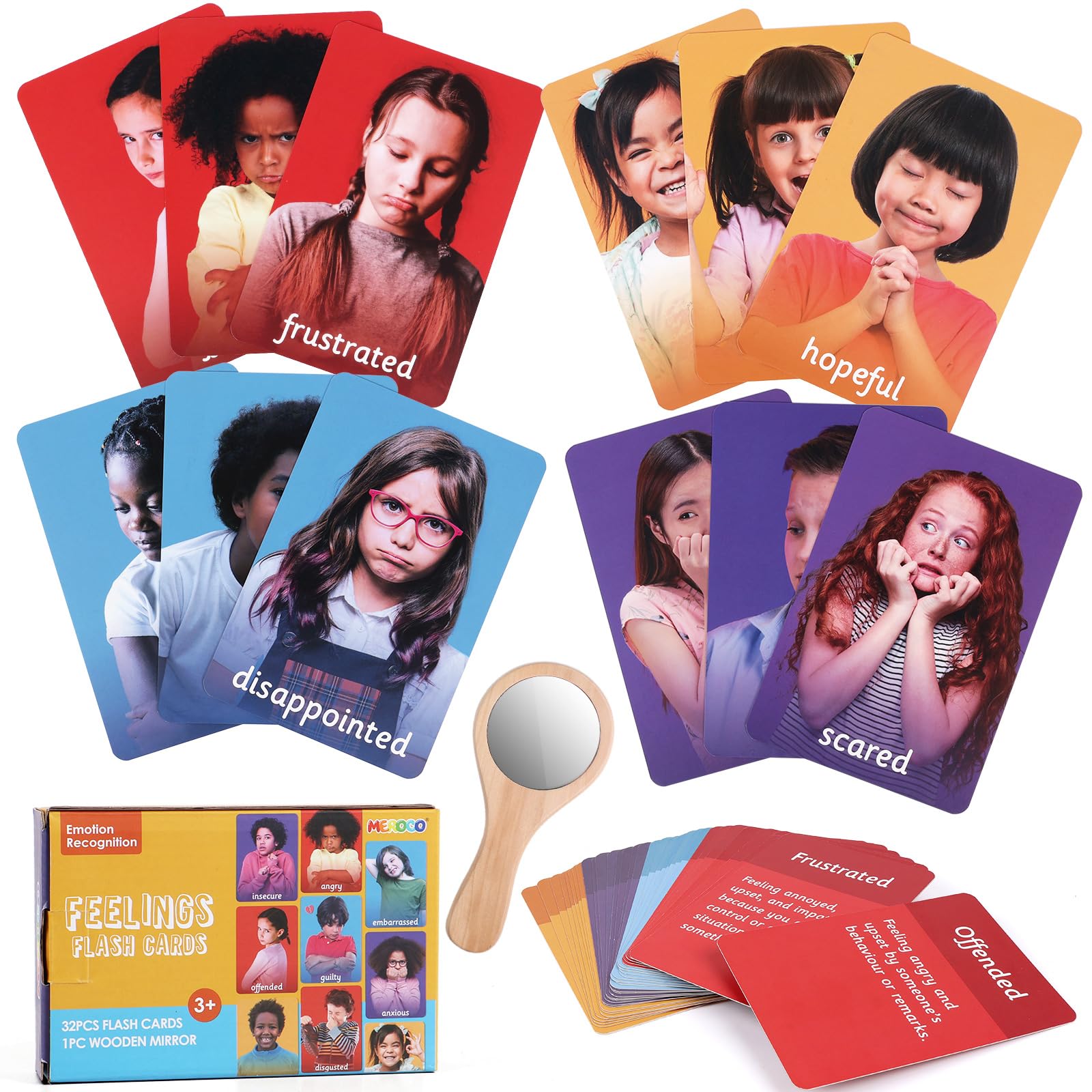
Real-Photo Emotion Cards with Mirror
A practical choice for naming feelings, comparing expressions, and the optional mirror activity in step 3.
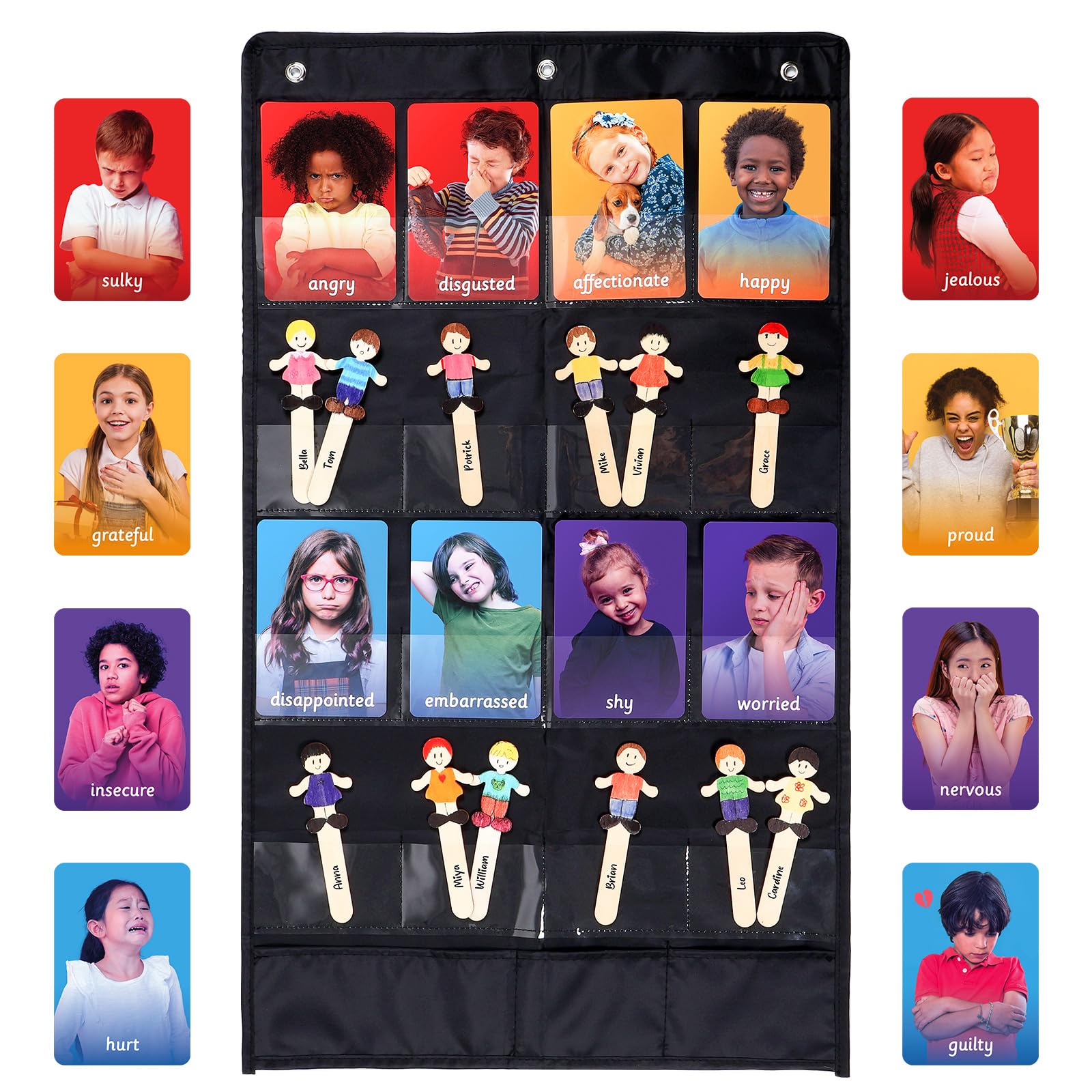
Emotion Cards and Feelings Chart
Designed for home or classroom check-ins, sorting activities, and repeat practice with a visual feelings chart.
| Activity | Suggested starting time | Extra materials |
|---|---|---|
| Look, notice, and name | 2–3 minutes | None |
| Match feelings | 3–5 minutes | Pairs or repeated feeling categories |
| Mirror exploration | 2–3 minutes | Child-safe mirror |
| Feelings check-in | 1–3 minutes | None |
| Story character | About 5 minutes | Book or stuffed animal |
| Different feelings | 3–5 minutes | None |
| What might help? | 3–5 minutes | Optional paper and pencil |
These times are flexible activity suggestions, not developmental targets. Finish earlier or continue if your child wants to.
1. Look, notice, and name
Set up: Choose two or three cards with different feeling words.
- Show one card and read its feeling word aloud.
- Describe something visible: “I notice the corners of this person’s mouth are turned up.”
- Place the card beside another one and invite your child to notice a difference or choose one to discuss.
Try saying: “This card says happy. What do you notice in the picture?”
Make it simpler: Name one card yourself and let your child hold or point to it. Add a challenge: Ask for an imaginary situation that could fit the feeling.
A picture gives you something to discuss, but a face alone does not tell you everything someone feels. Use phrases such as “might feel,” and ask real people how they feel instead of deciding for them.
2. Match feelings
Set up: Pick a few matching pairs, or cards that share a feeling label. If your deck has only one card per feeling, try another activity instead.
- Put one card from each pair face up on the table.
- Offer the remaining cards one at a time.
- Invite your child to find the matching picture or feeling word. Say which kind of match you are looking for.
Try saying: “These pictures are different, but both cards say sad. Shall we put them together?”
Make it simpler: Offer two possible matches. Add a challenge: With exact pairs, turn a few cards face down for a memory game. Keep the focus on playing together, without a speed target.
3. Explore expressions with a mirror
Set up: Place a child-safe mirror next to one emotion card.
- Look at the card together and name its feeling word.
- Ask whether your child would like to explore an expression in the mirror. You can take a turn first.
- Notice what changes when you move your eyebrows, mouth, or cheeks.
Try saying: “I raised my eyebrows. What changed? Would you like a turn, or would you rather watch?”
Make it simpler: Let your child observe you. Add a challenge: Explore two different expressions that could go with the same feeling.
Copying an expression is optional. There is no required “correct face,” and children do not need to make eye contact or imitate you to participate.
The MEROCO real-photo emotion card set with a mirror includes a mirror for this type of activity. Check the product listing for current set details.
4. Try a feelings check-in
Set up: Choose a quiet moment, such as after a snack or before a story, and lay out a small selection of cards.
- Take a turn yourself: “I feel happy that we have time to read together.”
- Invite your child to choose a card, name another feeling, or pass.
- Listen without changing the answer. Ask whether they want to tell you more.
Try saying: “Does one of these fit how you feel, or is it something else?”
Make it simpler: Accept pointing without an explanation. Add a challenge: Invite your child to choose two cards if they have mixed feelings.
In a classroom, offer a private check-in or the option to pass. Children do not need to explain personal experiences to the group.
5. Give a story character a feeling
Set up: Bring a picture book or a stuffed animal and a few cards.
- Pause at one moment in a story, or invent a short scene: “Bear’s tower fell over.”
- Ask your child to choose a card that could fit the character.
- Continue the story using the chosen feeling, then ask what might happen next.
Try saying: “Bear might feel sad or angry. Which feeling would you choose for our story?”
Make it simpler: Offer two cards. Add a challenge: Give a second character a different feeling and tell the story from their point of view.
6. One situation, different feelings
Set up: Choose an ordinary imaginary situation, such as arriving at a birthday party.
- Describe the situation without naming a feeling.
- Choose cards separately, then share your choices.
- Give each choice a possible explanation.
Try saying: “One child might feel happy to see friends. Another might feel worried because they don’t know anyone yet. Could both make sense?”
Make it simpler: Explain both possibilities yourself. Add a challenge: Change one detail: “What if a familiar friend arrives?” Invite a new card choice without requiring it.
This is a discussion rather than a quiz with one answer. Keep scenarios imaginary if your child does not want to talk about personal events.
7. Ask what might help
Set up: Pick a card for a fictional character. Have paper nearby if you want to draw ideas.
- Describe a simple scene: “Rabbit feels sad because playtime with a friend is over.”
- Ask what Rabbit might want: company, a quiet moment, or help making a plan for another day.
- Let your child suggest an idea. You can act out asking for support with a stuffed animal.
Try saying: “Would Rabbit like someone to listen, or some help? How could we ask?”
Make it simpler: Offer two options. Add a challenge: Practice a sentence such as “Can you sit with me?” or “I would like some space.”
The character does not have to become happy by the end. Leave room for the feeling while exploring a kind response.
How to choose an activity for today
For a first session, try naming two cards and stop there. If your child enjoys matching objects, start with a card match. If they prefer pretend play, use a stuffed animal. For a familiar daily routine, choose a short check-in.
Return to activities your child enjoys before adding more cards or questions. If the activity starts to feel frustrating, put it aside and try another time.
Frequently asked questions
How many emotion cards should I start with?
Try two or three as a manageable starting point. Use fewer if needed, and add cards when your child wants more choices. There is no need to introduce the whole set at once.
Does my child need to read or speak to join in?
You can read the labels aloud. Your child can point, hand you a card, gesture, or use their usual way of communicating. Spoken answers are optional.
What if my child picks a different feeling than I expected?
During a personal check-in, accept their answer. In a story activity, ask what made them choose it. If you are practicing a printed label, read the word together while allowing other interpretations of the picture.
Are real photos better than illustrated emotion cards?
Either format can be used for these games. Consider which pictures your child wants to explore and whether the labels are clear. A real-photo set offers photographs to discuss, but the format alone does not guarantee a learning outcome.
Can I use these emotion card activities with a small group?
Yes. Start with a shared story or a matching game, offer turns, and let children pass. Use fictional characters when you want a group discussion without asking children to share private feelings.
Choose a set for your next activity
Look for clear pictures, feeling words you want to explore, and a format that fits your planned game. For mirror play, choose a set with a mirror; for matching, check that the cards include suitable pairs or repeated feeling categories.
[…] case from preschool circle time highlights the use of targeted emotional literacy activities. When a group of kids learned to identify their feelings using picture cards […]
[…] create calming pockets in busy travel days. Research from 2015 showed that 70% of children with autism improved emotional regulation when using tactile or auditory aids during transitions and unfamiliar […]
[…] and insights to guide you step-by-step. Let’s dive into how you can help a child with autism flourish through sensory play and emotional […]