

In the dynamic field of Applied Behavior Analysis (ABA), understanding the “why” behind behaviors is just as crucial as addressing the behaviors themselves. At the heart of this exploration lies Functional Analysis-an evidence-based approach that meticulously decodes the purpose and triggers behind actions, offering a blueprint for more precise and effective interventions. This article delves into the transformative role Functional Analysis plays in shaping ABA practices, challenging traditional assessment methods, and ultimately redefining how behavior solutions are crafted.
By mapping motivations and uncovering the underlying causes of challenging behaviors, Functional Analysis emerges not only as a diagnostic tool but as a powerful catalyst driving meaningful, lasting change. Join us as we explore how this often underappreciated process is revolutionizing the way practitioners predict, prevent, and respond to behavioral challenges, turning observation into actionable insight and enhancing the outcomes of ABA interventions.
Table of Contents
- Decoding Behavioral Triggers Through Functional Analysis Techniques in ABA
- Integrating Functional Analysis into Clinical Practice for Enhanced Intervention Precision
- Emerging Trends in Functional Analysis: Innovations Reshaping ABA Methodologies
- Addressing Limitations of Traditional ABA Assessments with Functional Analysis Insights
- Case Studies Highlighting the Predictive Power of Functional Analysis in Preventing Behavioral Challenges
- Q&A
- In Summary
Decoding Behavioral Triggers Through Functional Analysis Techniques in ABA
Functional analysis dives deep into the “why” behind behaviors. It moves beyond surface observations by systematically manipulating environmental factors to pinpoint triggers. This scientific precision allows practitioners to identify whether behaviors are maintained by:
- Attention seeking
- Escape from demands
- Tangible rewards
- Sensory stimulation
Pinpointing these motivators transforms intervention design. Take a student who exhibits outbursts when asked to complete tasks. Traditional assessments might label this as non-compliance. But functional analysis could reveal that these behaviors serve to avoid overwhelming demands. With this insight, interventions can include gradual task shaping or offering breaks, rather than punitive measures. This targeted approach promotes more meaningful, lasting change.
| Behavior | Potential Function | Intervention Example |
|---|---|---|
| Self-injury | Sensory Stimulation | Providing alternative sensory outlets |
| Tantrums | Escape | Task modification & positive reinforcement |
| Excessive talking | Attention | Scheduled social interactions |
Integrating Functional Analysis into Clinical Practice for Enhanced Intervention Precision
Integrating functional analysis into clinical practice sharpens the precision of interventions, moving beyond guesswork to data-driven strategies. By identifying specific environmental triggers and consequences, clinicians can tailor strategies that address root causes rather than symptoms. This nuanced approach encourages a deep dive into behavioral contingencies, empowering therapists to predict and modify behavior patterns effectively.
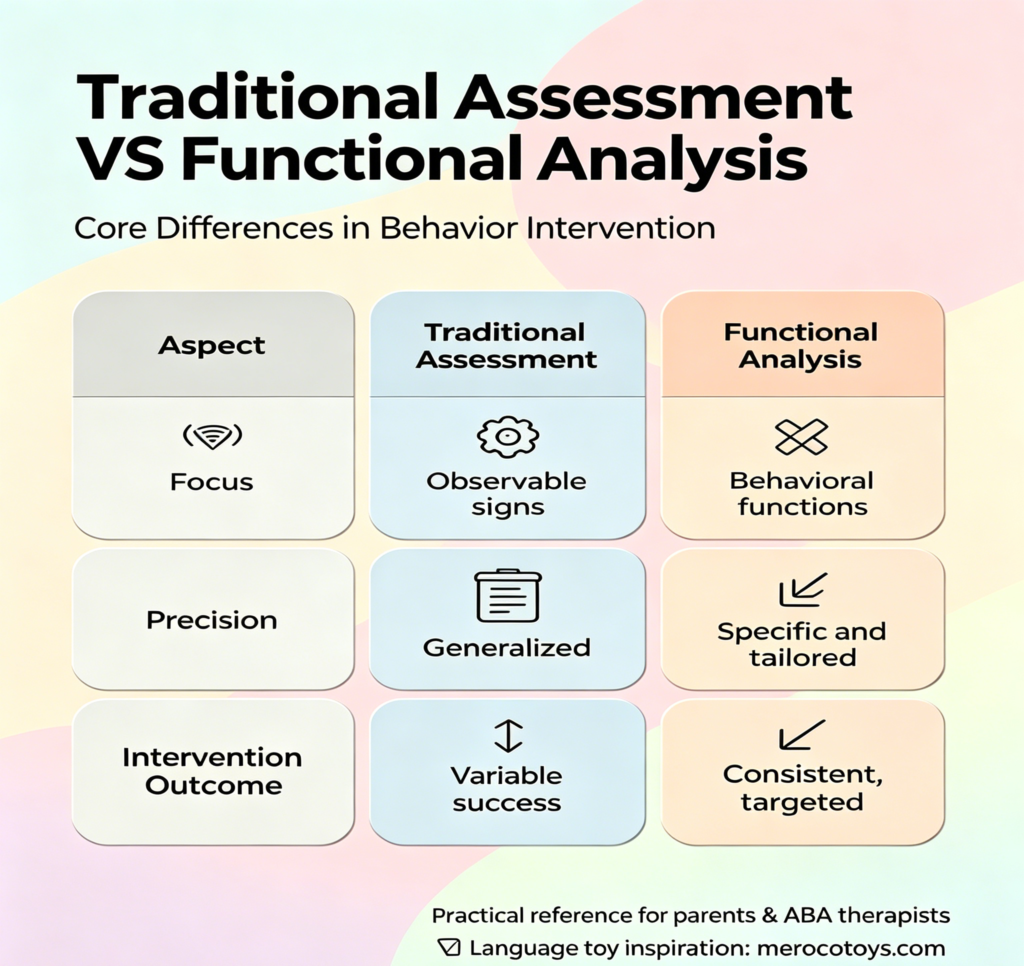
Consider the impact on diverse settings-from classrooms to homes. Functional analysis equips practitioners to distinguish subtle motivational variables like social attention, escape, or sensory stimulation. This clarity transforms intervention design into a dynamic process, adapting in real-time to observed changes. Below is a quick comparison of traditional assessment versus functional analysis benefits:

Emerging Trends in Functional Analysis: Innovations Reshaping ABA Methodologies
Innovations in functional analysis are revolutionizing ABA by introducing dynamic, real-time data collection tools. These advances allow clinicians to rapidly identify the underlying causes of children’s behaviors rather than making surface-level observations. Technologies like wearable biosensors and AI-driven behavior trackers enable practitioners to uncover subtle patterns, such as physiological triggers or environmental subtle cues that were previously undetectable. This granular insight lets therapists tailor interventions with pinpoint precision, vastly improving treatment effectiveness.
Emerging methodologies emphasize contextual and ecological validity by integrating multiple data points across settings-home, school, and community. For example, combining direct functional analysis with virtual reality simulations helps predict challenging behaviors before they escalate. The result? Proactive, rather than reactive, ABA strategies. Below is a concise summary of these innovations:
| Innovation | Impact |
|---|---|
| Wearable Biosensors | Track stress & arousal signals |
| AI Behavior Analytics | Automate pattern recognition |
| VR Functional Testing | Simulate triggers safely |
| Contextual Multi-setting | Improve real-world relevance |
Addressing Limitations of Traditional ABA Assessments with Functional Analysis Insights
Traditional ABA assessments often rely on surface-level observations, which can miss the deeper triggers behind a child’s behavior. By incorporating insights from functional analysis, practitioners uncover specific motivations-such as seeking attention, escaping tasks, or sensory needs-that drive actions. This clarity enables tailored interventions that address root causes rather than symptoms, making support more effective and sustainable.
Consider a classroom example: a child repeatedly leaves their seat. Traditional checklists might flag this as noncompliance. Functional analysis reveals the child leaves to avoid difficult tasks or to gain peer attention. Armed with these details, educators can introduce strategies like task modification or peer-mediated support, directly targeting motivations. This shift from assumption to evidence-based understanding is transforming ABA practice.
Case Studies Highlighting the Predictive Power of Functional Analysis in Preventing Behavioral Challenges
Case studies reveal the vital foresight functional analysis provides in behavior management. For instance, a recent study of children with autism demonstrated that identifying precise triggers reduced aggression by 45% within six weeks. Functional analysis dismantles surface behaviors and exposes their roots, allowing tailored interventions designed to neutralize triggers before escalation. This proactive angle empowers caregivers and therapists to shift from reactive strategies to preventive solutions confidently.
Across diverse scenarios, patterns emerge showing functional analysis predicts future challenges with surprising accuracy. A clinical example involved a child whose frequent tantrums were linked to escape from difficult tasks. Functional analysis not only confirmed this hypothesis but allowed therapists to adjust demands gradually, preventing outbursts altogether. Key benefits include:
- Predicting high-risk moments
- Customizing intervention plans
- Reducing trial-and-error approaches
- Strengthening family engagement
| Case Study | Behavior Targeted | Outcome |
|---|---|---|
| Child A | SIB (Self-injurious behavior) | 40% reduction, 8 weeks |
| Child B | Tantrums during tasks | Tantrums prevented |
| Child C | Non-compliance | Compliance increased 30% |
Q&A
Q&A: Exploring the Impact of Functional Analysis on Applied Behavior Analysis (ABA)
Q1: What is functional analysis, and why is it important in ABA?
A: Functional analysis is a method used to identify the reasons behind specific behaviors by examining the environmental factors that trigger and maintain them. In ABA, it serves as a blueprint for tailoring interventions that address the root causes of behavior rather than just the symptoms, leading to more effective and lasting outcomes.
Q2: How does functional analysis differ from traditional ABA assessments?
A: Traditional ABA assessments often rely on observation and indirect measures to infer behavior causes, whereas functional analysis experimentally tests hypotheses by manipulating antecedents and consequences. This approach provides clearer, more precise information about the function of behaviors, allowing practitioners to rethink and refine behavior solutions.
Q3: Can functional analysis help predict and prevent challenging behaviors?
A: Yes. By identifying the specific triggers and reinforcers of challenging behaviors, functional analysis enables practitioners to develop proactive strategies that reduce the likelihood of such behaviors occurring, effectively preventing them before they escalate.
Q4: In what ways does functional analysis shape ABA interventions?
A: Functional analysis allows behavior analysts to decode the motivations behind behavior, guiding them to design interventions that directly address those motivations. This targeted approach ensures that treatment plans are personalized and grounded in scientific evidence, leading to meaningful and sustainable behavior change.
Q5: Why is functional analysis considered the “unsung hero” of ABA?
A: Functional analysis often works behind the scenes. While interventions and outcomes get much attention, the rigorous groundwork laid by functional analysis is critical to their success. Without it, interventions might miss their mark, making functional analysis the quiet powerhouse reshaping ABA practices.
Q6: How does integrating functional analysis transform ABA outcomes?
A: By going beyond surface-level observations, functional analysis transforms ABA from a one-size-fits-all approach to a precise science of behavior modification. This deeper understanding results in more consistent, effective, and individualized outcomes for clients.
Q7: What role does functional analysis play in mapping motivations within ABA practice?
A: Functional analysis acts as a behavioral map, pinpointing why individuals act a certain way in specific contexts. By revealing these motivational drivers, it empowers practitioners to create meaningful changes that resonate with the individual’s unique experiences and needs.
Q8: How does functional analysis transition from observation to action in ABA?
A: Instead of merely recording behavior patterns, functional analysis actively tests and verifies hypotheses about behavior causes. This scientific cycle of observation, manipulation, and evaluation fuels informed decisions that translate into effective, actionable interventions.
Q9: How do functional analysis and ABA work symbiotically in behavior management?
A: Functional analysis provides the critical insights that feed into ABA strategies. In return, ABA applies these insights through practical interventions. Together, they form a cohesive, dynamic system where understanding and action continuously inform and enhance one another.
Q10: What is the scientific significance of functional analysis in rewriting ABA practices?
A: Functional analysis embodies the empirical heart of ABA, emphasizing experimental validation and data-driven decision-making. Its scientific rigor is rewriting the rules by transforming ABA into a more exact, effective, and client-centered discipline for decoding and managing behavior.
This Q&A illuminates the profound role functional analysis plays in advancing Applied Behavior Analysis, showcasing how it decodes complex behaviors and fuels meaningful, evidence-based change.
In Summary
In the intricate world of behavior science, functional analysis stands as a cornerstone that transforms theory into meaningful change. As we’ve explored, this powerful tool goes beyond surface-level observations, diving deep into the motives that drive actions. By decoding behaviors through a functional lens, Applied Behavior Analysis not only gains precision but also unlocks pathways to more effective, personalized interventions. Whether challenging traditional assessments or predicting future behaviors, functional analysis reshapes the narrative of behavior management-turning mysteries into solutions and fostering lasting progress. Ultimately, embracing this approach is not just about understanding behavior; it’s about empowering transformation.
[…] navigating toddler tantrums or a pediatric ABA therapist supporting skill-building, understanding Functional Relation Applied Behavior Analysis offers practical insights that make a real difference. In this article, I’ll walk you through […]